 By Mark Evans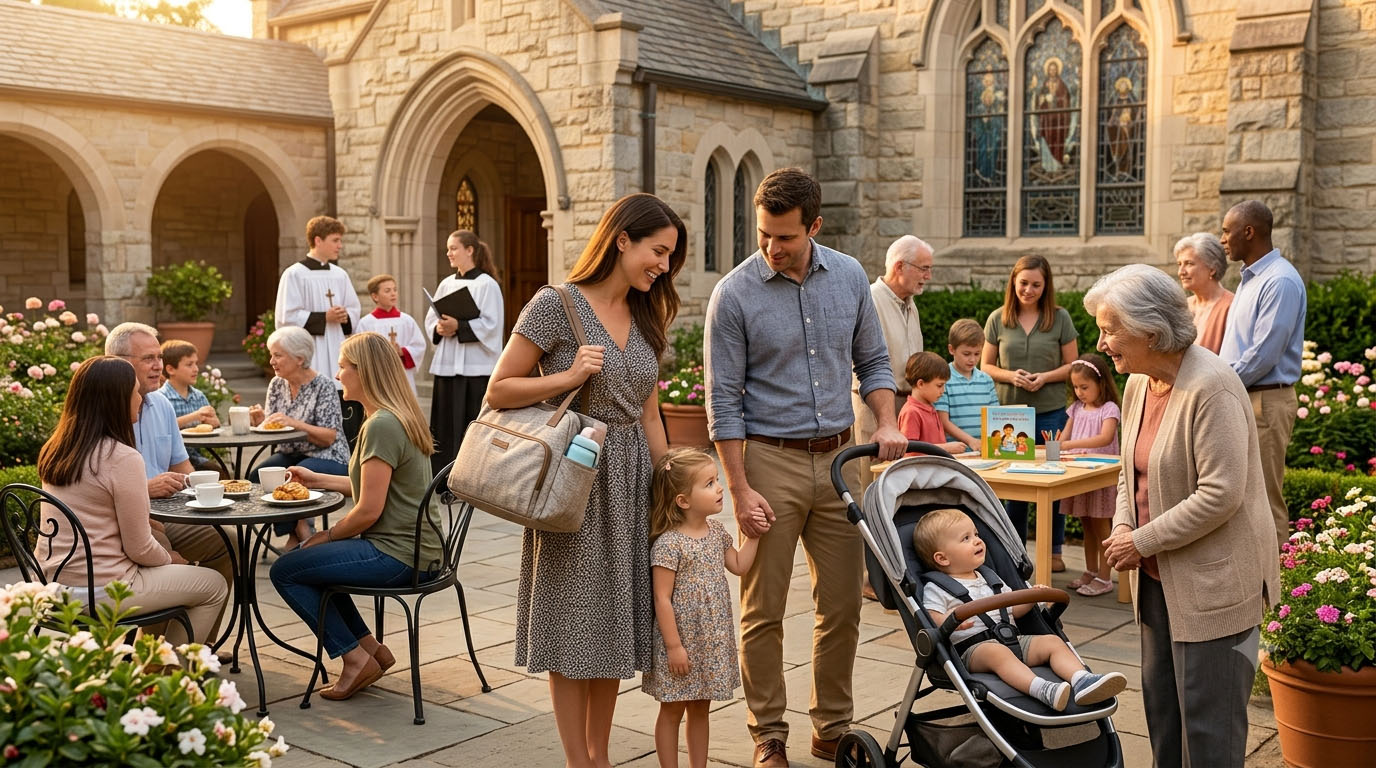
A young family rarely needs only one kind of support. Parents may be carrying a baby bag, a tired toddler, a quiet worry about school fees, and a deep wish to raise children with faith, kindness, and courage. In many Catholic communities, the parish becomes more than a place for Sunday Mass. It becomes a second circle of care, where families are known by name, children learn they belong, and parents find people who understand both the joy and strain of family life.
Faith communities support young families by offering spiritual formation, friendship, practical encouragement, and shared moral language. A parish cannot replace the work parents do at home, but it can strengthen it. Many mothers and fathers also draw on wider resources for child development and parenting advice, especially when they need age-based guidance alongside the steady support of church life.
A helpful view for busy parents
Catholic parishes support young families through worship, children’s ministries, service opportunities, intergenerational friendship, and pastoral care. The strongest communities do not treat children as interruptions. They treat them as part of the Church’s living future.
A parish gives families a place to belong
Family life can feel lonely, even in a busy town. New parents may spend long hours caring for a child with little adult conversation. Couples may attend Mass while wondering whether their baby’s cries are disturbing everyone. Parents with energetic preschoolers may feel embarrassed when their children wriggle, whisper, or ask questions at the wrong time. A welcoming parish helps remove that fear.
The first gift a faith community gives is belonging. A smile at the church door, a kind word after Mass, or a patient nod when a child becomes restless can change how a young family feels about returning the next week. In Catholic life, the parish is not meant to be a hall filled with perfect people. It is a household of faith, which means babies, grandparents, teenagers, widows, new converts, and tired parents all have a place.
Catholic communities in Malaysia often express faith through worship, charity, education, and social responsibility. The same spirit appears in Catholic social teaching, where dignity, care for others, and concern for the common good shape ordinary family decisions.
Children learn faith by watching adults live it
Children do not learn faith only through formal lessons. They learn it when they watch adults pray, forgive, serve, share food, greet the elderly, and show reverence during Mass. A parish gives children a living classroom. They see that faith is not just something their parents talk about at home. It is something practiced by a whole community.
Parents also benefit from this shared witness. Raising children in faith can be difficult when home life is rushed. School, work, homework, meals, and transport can fill the week. Parish life creates repeated moments that bring families back to prayer and reflection. Even simple routines, such as attending Mass together or joining a parish feast day, remind families that faith is meant to be lived in community.
Practical ways parishes can support young families
Support for families does not need to be complicated. Many helpful actions are simple, consistent, and deeply human.
- Make Mass feel accessible for children.
Clear signs, family-friendly seating, gentle ushers, and a welcoming attitude help parents relax. A small children’s corner with faith-based books can support younger children without making families feel separated from worship. - Offer age-appropriate faith formation.
Children need teaching that matches their stage of growth. Stories, songs, art, simple prayers, and guided activities help them understand God’s love before they are ready for deeper theological language. - Create parent friendship circles.
Short gatherings after Mass, parent coffee mornings, or family potluck meals allow parents to meet others with similar concerns. These friendships often become a quiet support system during stressful seasons. - Include children in parish service.
Children can help pack food, make cards for the sick, collect supplies, or join simple outreach projects. Service teaches compassion in a concrete way, especially when adults explain who is being helped and why it matters. - Offer pastoral care without judgment.
Some families face grief, financial stress, marriage strain, special learning needs, or uncertainty about faith. A parish that listens with patience gives parents the courage to ask for help early.
Shared values help parents feel less alone
Parenting often involves small decisions that carry moral weight. How should a child be taught to apologize? How can siblings learn to share? What should parents do when a child lies, excludes another child, or struggles with anger? Faith communities help because they give families a shared language for mercy, honesty, gratitude, patience, and responsibility.
Parish communities also provide older role models. A young mother may learn from a grandmother who raised five children. A father may gain perspective from another parent who has guided teenagers through difficult years. Children benefit from seeing faithful adults at different life stages. These relationships remind families that parenting is not meant to be done in isolation.
How children’s ministries strengthen family life
Children’s ministries can guide children when they are thoughtful and carefully led. Catechism classes, children’s liturgy, altar serving, youth choir, and family retreats all give children ways to participate. They also help parents continue faith conversations at home. A child who learns about forgiveness in class may ask a parent what it means during a sibling argument. A child who sings at Mass may begin to feel that worship belongs to them too.
In Penang and across Malaysia, Catholic education and parish formation have often worked side by side. The tradition of Catholic schools shows how faith, learning, discipline, and service can shape young people over many years. Parish ministries can support the same growth, even for children who attend different schools or come from mixed-faith households.
What different forms of support can look like
Young families need support in many areas at once. A parish may not be able to offer everything, but it can build a healthy mix of spiritual, emotional, and practical help. The table below shows how different kinds of parish support can meet real family needs.
| Family need | Parish support | How it helps |
|---|---|---|
| Spiritual rhythm | Mass, prayer groups, feast days | Gives children steady habits of worship and gratitude |
| Parent encouragement | Parent circles, mentoring, pastoral care | Reduces isolation and helps parents seek guidance |
| Child formation | Catechism, children’s liturgy, youth choir | Makes faith understandable, joyful, and participatory |
| Moral growth | Service projects and community outreach | Teaches compassion through action rather than slogans |
Fellowship gives parents strength for ordinary days
Not every act of support looks religious at first glance. Sometimes it looks like another parent holding a baby while a mother drinks water. Sometimes it looks like a parishioner helping a family find a seat. Sometimes it is a message after a difficult week, a meal shared after Mass, or a quiet assurance that a restless child is welcome.
The Catholic understanding of family has often emphasized love, commitment, patience, and openness to life. Pope Francis reflects on many of these themes in family life, especially the need for tenderness, realistic care, and pastoral closeness. For parishes, that vision becomes practical when families feel seen rather than judged.
Healthy parish culture starts with small habits
- Welcome children’s presence instead of treating them as distractions.
- Speak kindly to parents who arrive late or look tired.
- Plan events at times that work for families with young children.
- Offer clear information about sacraments, classes, and parish groups.
- Make space for single parents, grandparents raising children, and mixed-faith families.
These habits communicate a message stronger than any noticeboard announcement. They tell families, “You belong here.” That message can be especially meaningful for parents who are returning to church after a long absence, raising children far from extended family, or trying to build faith routines for the first time.
Faith and practical guidance can work together
Parish communities are strongest when they respect the full reality of family life. Spiritual care matters, alongside meals, routines, friendships, mental rest, learning needs, and safe spaces for children to grow. Young families thrive when the Church speaks to the soul while also recognizing daily pressures.
Growing families, growing parish life
Young families bring noise, movement, questions, and fresh hope into a faith community. They remind a parish that the Church is not only preserving memory, but forming the next generation. When parents are supported, children are more likely to experience faith as loving, steady, and meaningful. When children are welcomed, the whole parish becomes more generous.
A Catholic community that supports young families does more than run programs. It practices patience. It builds friendships. It teaches children through worship and example. It gives parents courage when they are tired. It helps families connect Sunday faith with weekday life. In that kind of community, young families are not visitors at the edge of parish life. They are part of its heart.